|
.Conservation of 19th Century Pianos: Promoting the documentation and preservation of pianos built in the last half of the nineteenth century.
The Period Piano Center Collection: Collecting Important Pianos, Artifacts and Documents
The Early Steinway Grand Research Project: Studying and teaching the history of Steinway piano design from 1856-1886
The Early Steinway Grand Classes. Click here for a detailed list of class choices and descriptions.
How to make a contribution to Period Piano Center, how the funds will be spent, and why your contribution is important to the preservation of piano history
This ongoing project seeks to develop a large database of information as a result of the documentation of a large number of Steinways from 1856 to 1886, compare that information to other makes from the period, and tell the remarkable story of the early Steinway Classes are taught at PTG events and other venues. A series of articles are being prepared for publication.
Recently documented pianos:
May 2009 in New York City, Steinway Centennial #33610 at Steinway and Sons Restoration Center, the earliest known existing modern Steinway concert grand
September 4, 2009, at Klavierhaus in New York City, Steinway #1225, the first art case Steinway and production twin to previously documented 1226. Incomplete session with partial but significant data..:
August 2008 in Santa Clarita, California, a 7’2” 1862 flat-strung Steinway grand, #
December 2008 in New Orleans, an 8’ flat-strung 1858 concert grand with original action. This piano has been in the same family since new. It survived two fires, including the Civil War burning of the mansion. It is a rare example of a completely-intact Henry Steinway Jr. action of English style.
Recent presentations: On March 15, 2008 Mr. Shull gave his 2 period “Early Steinway Grand, 1856-1886” at the Pacific Northwest Conference of the Piano Technicians Guild. On March 24 he presented “Discovering the Early Steinway Grand” at the Las Vegas Chapter of the Piano Technicians Guild, and on May 20 to the Boston Chapter of the Piano Technicians Guild.
August 2, 2008 he conducted an all-day Early Steinway Grand Seminar in Modesto, CA at the shop of Dale Erwin, sponsored by the Modesto Chapter of the Piano Technicians Guild. A vintage 1864 Steinway grand owned by technicians Bob and Marcia Davis was on hand to view.Â
Recent Exhibits
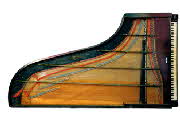
Period Piano Center has begun to exhibit. The first exhibit was at the California State Conference of the Piano Technicians Guild in Burbank, CA in February 2009. An 1869 “double-iron” Steinway vertical was exhibited with all components removed to show the “Patent Resonator” plate design with soundboard compression bolts.
The next exhibit was at the Mid-Atlantic Regional Conference (MARC) April 23-26 in Harrisburg, PA.. Laurence Libin, Steinway Honorary Curator and Curator Emeritus of the Metropolitan Museum of Art, and Piano Technician Larry Buck, PianoTechnical Photographer, assisted with the exhibit. http://propta.net/ptgmarc/
Conservation of 19th Century Pianos:Â Nineteenth-century pianos are losing their authenticity through often well-intentioned, un-informed rebuilding or re-manufacture at an alarming rate. Manufacturers and rebuilders often endorse the replacement of original parts with new, without considering the importance of retaining original, unique actions, strings and other components. Learn how to conserve these pianos and prevent the loss of these great records of the genius of men such as Jonas Chickering, Theodore Steinway and Sebastian Erard.
The Early Steinway Grand Research Project: Click to learn about this extensive research project on the early Steinway, learn recent news of site visits and documents, learn about how to secure a consultation or attend a lecture; and learn how to become a research partner.
THE PERIOD PIANO CENTER
The collection currently includes four Erard pianos, an 1840s concert grand, an 1870s 7’ grand, an1820 vertical, and an 1870s vertical. It includes three early Steinways, an 1867 double-iron vertical, an 1870 double-iron vertical and an 1871 7’2” Style 2 grand. Also in the collection is an 1880s 6’5’ Chickering with a Brown action. The collection should eventually include a piano from each important period, with an emphasis on several pianos from 1820 to 1880. Replicas will also be sought from each period and style. A focus on the Erard piano in the 19th century will result in a collection of instruments from early Erards (from Beethoven Erard) to the Erard used by Debussy. Click here for a list of the collection.
A focus on the early Steinway should include original and restored instruments, flat-strung, sectional-plate grands, traditionally built grands, and first-generation modern grands. Monitor ancestors - especially with their original CFT Steinway action, and early sectional and late continuous rim examples of the first great Steinway concert grand, the “Centennial.” Even an early (1884-1892) model “D” should be included - with its unusual string terminations and exotic duplex in the tenor range.
An education and research component would fund ongoing seminars on the conservation of pianos for piano technicians, pianists and academicians. It would fund a project similar to the extraordinary “Organ Restoration Reconsidered,” edited by John R. Watson, and published by the Detroit Monographs in Musicology. This project establishes the benchmark for organological study in the piano arena. Study of the piano is 40 years behind that of the organ, and the consequences are dire for piano researchers attempting to recover history. A great need exists to fund a project which coordinates the work of experts in the field of piano conservation and restoration, and educates piano manufacturers, wholesale rebuilding shops, piano technicians, piano retailers, pianists and teachers. This project should find its way into the published musicological references, as Watson’s work has been published by the famed Detroit series, and bear an influence which will impact piano service/restoration practices throughout the world.
The Center will accept donations and contributions of pianos, as well as a land or building gift suitable for the center’s collection and storage needs.
Re-salable items, such as unwanted automobiles, which could aid in fundraising for the Center, are also accepted, and all gifts might be considered a tax-deductible contribution for 2009.
SPECIFIC NEEDS, or CASH SUPPORT TO OBTAIN:
Computer capable of supporting museum website, documentation project (including web server to support web-based piano documentation project)
Funding for museum website. This includes the initial website development and the ongoing costs to maintain website. The website provides not only the necessary public presence, but the basis for the digital museum to be accessible to researchers and the general public.
Funding for staffing:
An Administrator. With curating or library director experience, this individual will undertake the primary responsibilities of coordinating and directing the archive and instrument collection and restoration activities of Period Piano Center, will manage the budget, will write or coordinate the writing of grants for funding, the restoration and conservation activities, the management of documents and archives, and perform the many other activities required of Period Piano Center.
Director of Research and Education:Â This individual will conduct and coordinate research and will perform most lecturing responsibilities.
Support Staff: Secretarial and documents management support will be needed to perform the day-to-day operations of the Period Piano Center.
Technical Staff: Conservators and Piano Technicians will be needed to perform procedures to prepare pianos for display and/or performance. Proper protocol for cleaning museum instruments is an expert activity requiring skill and significant time. Expert restoration skill will be required of conservators and technicians to prepare instruments which have been dedicated to performance use.
|