 |
|
|
A California Non-Profit Corporation email contact Donations Bill Shull, RPT, M.Mus. Founder and President New Location: 610 Amigos Dr B1, Redlands, CA 92373 |
|
|
|
MIM of the WEST Musical Instrument Museum of the West The newest musical instrument museum in North America is the MIM in Phoenix, Arizona. A “world” MIM, including instruments from throughout the world and from most cultures, it was built by the former TARGET CEO, who has had a passion for musical instrument support in the past (funding for the Cristofori copy made by Thomas and Barbara Wolf off of plans made from the real thing when it was on loan for the Piano 300 Smithsonian Exhibit is a good example). This excellent museum has only one drawback: location. Why not locate a world MIM in a large, multicultural center such as Los Angeles or the Bay Area? The greater Los Angeles area is a large multicultural center, with all continents well-represented. The objective of a world MIM is multifold: In a large, multicultural metropolitan area it can help divergent cultures to remember their heritage through instrument conservation and exhibits, as well as through the use of the instruments in a large variety of ongoing concerts. Period Piano Center would, of course, wish to be contained in a section of the museum and include a thorough collection of keyboard instruments from the earliest to the most recent. Not only would a large collection of pianos be included, but conservation of pianos could be taught as augmenting the course work of the piano technician and the musical instrument conservator. Several performance venues would permit the appropriately sized venue for the instrument, of for the instrument ensemble. A multicultural MIM in a large center such as greater Los Angeles would have very positive consequences. As a tourist center, it would be one more attraction. but peoples would be able to remember or learn their histories, as well as that of other cultures. A large MIM would be a significant and permanent financial undertaking. Prime property, building and/or renovation of structures, architecturally appropriate designs, hiring and maintenance of curatorial, conservation and performance staffs, along with marketing and community outreach personnel, would require a multi-million dollar startup and annual budget. In north America Musical Instrument museums are represented by the new MIM in Phoenix, “Vermillion” or the National Music Museum (NMM) in Vermillion, South Dakota, the collections at the Metropolitan Museum of Art in N.Y. and the Smithsonian Institute in Washington, D.C., the Yale Musical Instrument Collection, the Boston Museum of Fine Arts (MFA) instrument collection, the Stearns Collection in Ann Arbor, Michigan, the Mathers Museum of World Cultures in Bloomington, Indiana, and the Calgary musical instrument collection. The UCLA collection, the Fiske Museum in Claremont CA., are no longer extant as public museums. The result of the establishment of a world music museum would be the regular performance of music on these instruments, and possibly the development of fine residence performance residence ensembles. Andean and African ensembles, as well as fortepiano and early modern pianos would see regular performance. Key to the success of this museum is its placement in a central, public-transportation accessible part of the greater metropolitan area. positioning near a museum center would be desirable but not essential. West LA, Pasadena, Alhambra, and central Los Angeles would be excellent sites. http://www.amis.org/resources/index.html#top
|
|
|
|
|
|
|
|
|
|
 |
||||||||
|
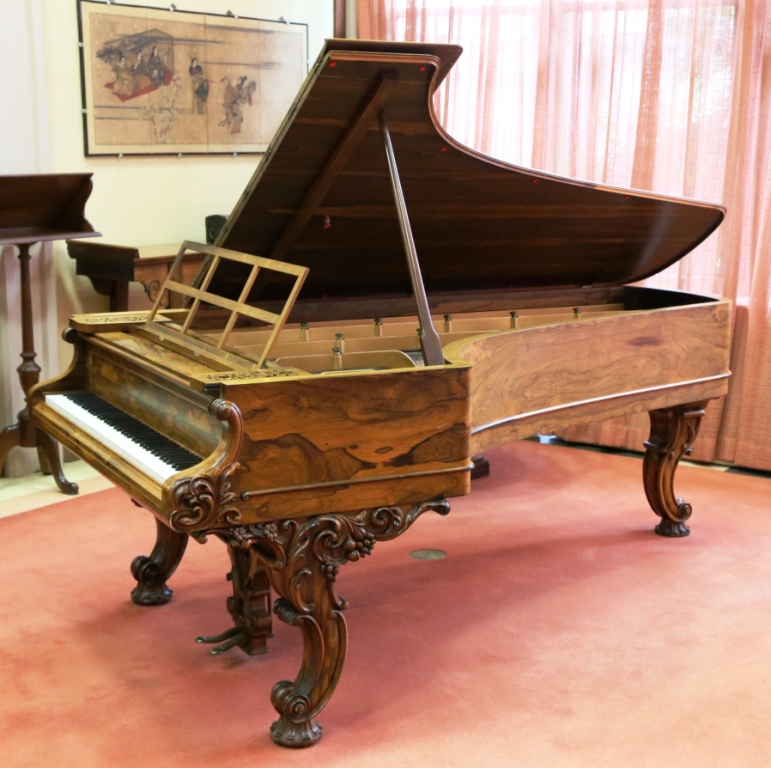
1859 Chickering - Pianist Frank French performed on February 27, 2015 in an all-Gottschalk concert |
||||||||
 |
||||||||
|
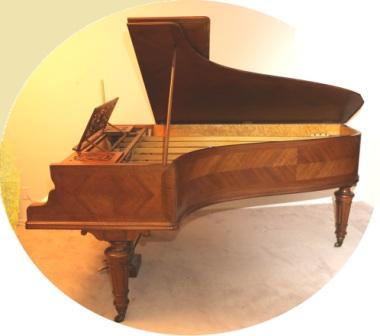
1911 Erard Grand |
||||||||
|
Pianist Jocelyn Swigger will perform a recital of the Chopin Etudes in the spring of 2016. |
||||||||